
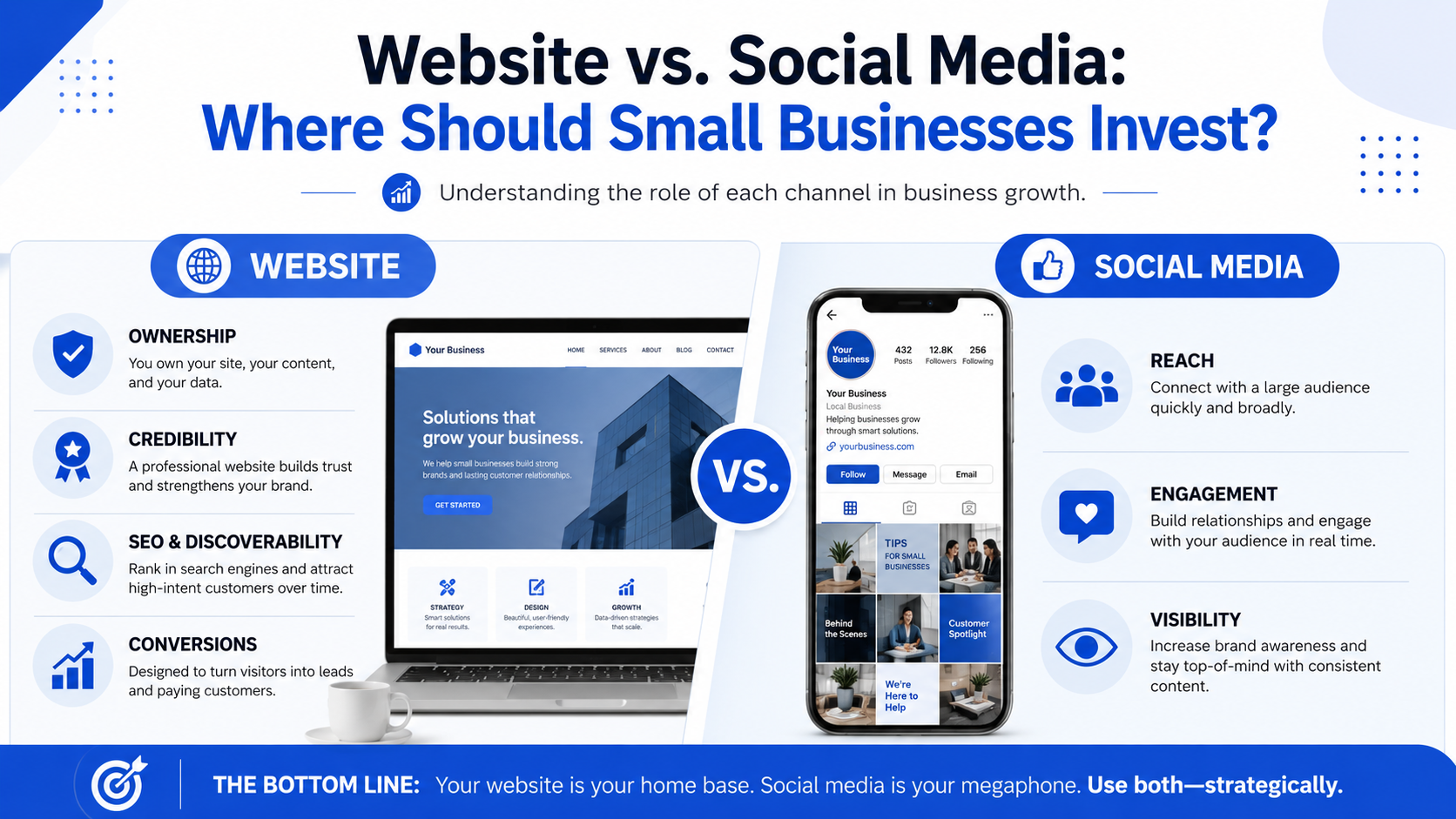
If you’re a small business owner trying to stretch every marketing dollar, you’ve probably asked yourself this question: do I really need a website, or can I just run my business off Instagram and Facebook?
It’s a fair question. Social media is free to start, feels more immediate, and meets customers where they already spend their time. But treating it as a replacement for a website — instead of a companion to one — is one of the most common (and costly) mistakes small businesses make.
Here’s how to think about where your time and budget should actually go.
What Social Media Does Well
Social media is fantastic for:
- Discovery — getting your brand in front of new people through shares, tags, and algorithm-driven reach
- Community — replying to comments, running polls, showing behind-the-scenes content
- Real-time updates — flash sales, event announcements, timely posts
It’s low-cost to start and lets you show personality in a way that feels casual and human.

Where Social Media Falls Short
The problem is what social media doesn’t give you:
- You don’t own it. Your account, your followers, your reach — all of it lives on a platform that can change its algorithm, suspend your account, or fold entirely.
- It’s not built to convert. A social profile is a poor place to explain pricing, book an appointment, or process a purchase.
- It doesn’t build long-term SEO value. Posts scroll away in hours. Google can’t meaningfully index and rank a social feed the way it can a website.
- It undercuts credibility. A growing share of customers still check for a real website before trusting a business, especially for higher-ticket services.
What a Website Does That Social Media Can’t
A website is the one piece of digital real estate you fully own. It’s where:
- People go to verify you’re legitimate before they buy or book
- Google sends organic search traffic — free, compounding, long-term visibility
- You control the message completely, with no algorithm deciding who sees it
- Every other marketing channel (ads, social, email, business cards) ultimately points people to convert
Think of your website as your home base, and social media as your outposts. Outposts are great for reach. But you still need a home base for people to land on.
So Where Should the Money Actually Go?
For most small businesses just getting started, a simple rule of thumb works well:
- Website first. Even a lean, well-built 4–5 page site (Home, Services, About, Contact, and one proof-point page like Testimonials or Portfolio) gives you a permanent, searchable foundation.
- Social media second, and only where your customers actually are. You don’t need to be everywhere — pick one or two platforms and post consistently rather than spreading thin across five.
- Let each channel do its job. Use social media to build awareness and trust, then drive that traffic back to your website where visitors can actually convert into leads or customers.

The Bottom Line
This isn’t really a “website vs. social media” decision — it’s a sequencing decision. Social media without a website is building on rented land. A website without any social presence misses out on discovery and reach. The businesses that grow fastest use both, with the website as the foundation everything else points back to.
Not sure if your current site is pulling its weight? Sokie Digital helps Nashville-area small businesses build websites that actually convert traffic into customers — not just digital brochures. Get in touch and let’s talk about where your budget will work hardest.