
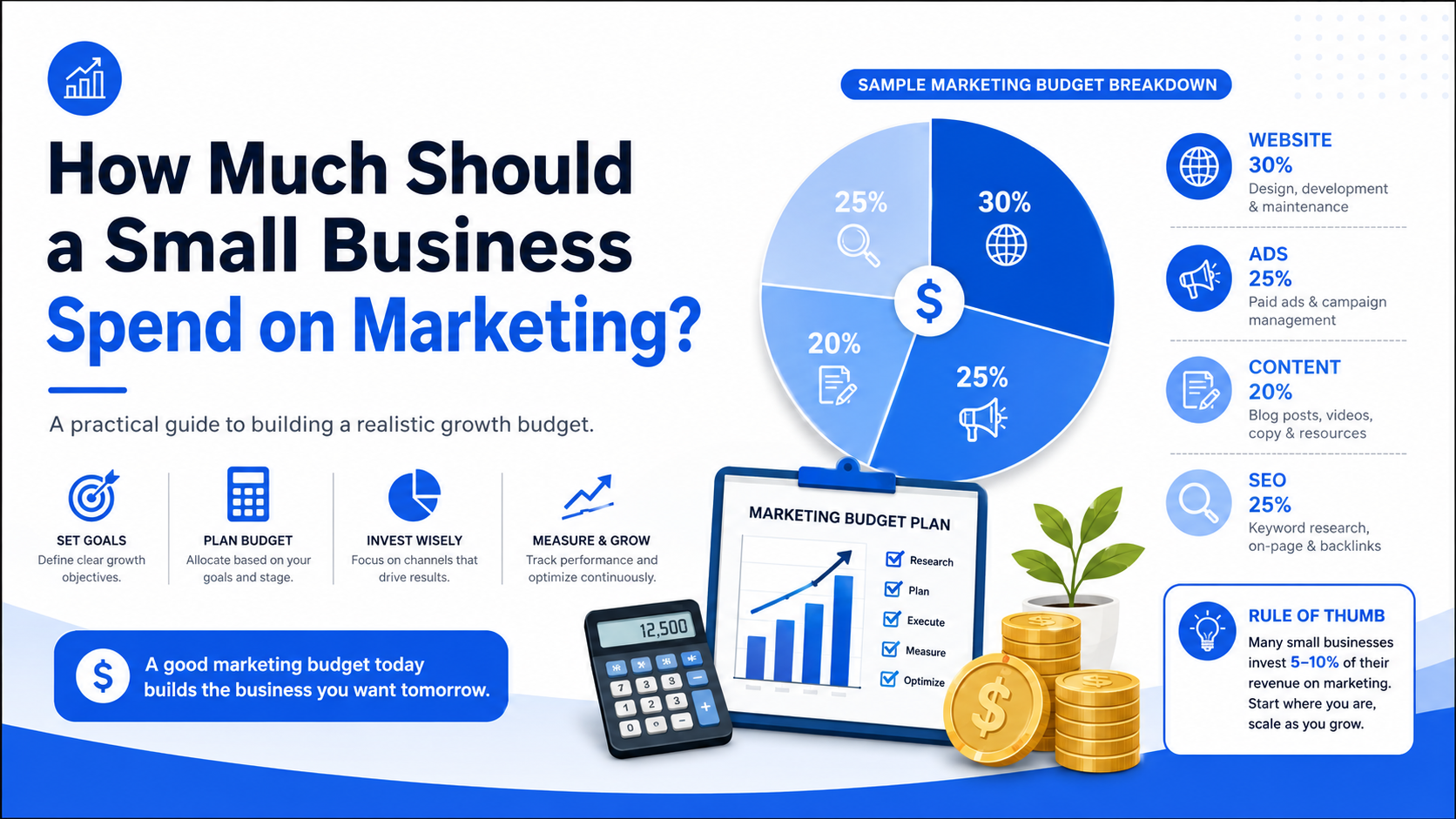
“How much should I be spending on marketing?” is one of the questions small business owners ask most — and one of the least clearly answered anywhere online. The honest answer is: it depends on your stage, your goals, and your margins. But “it depends” isn’t very useful on its own, so let’s put some real numbers around it.
The General Benchmark
Most small business advisors point to a range of 7–10% of gross revenue for businesses that are established and stable, and up to 12–20% for businesses in growth mode or trying to build brand awareness from scratch.
A few factors shift you up or down within that range:
- New business or new market? Lean toward the higher end — you’re building awareness from zero.
- Established with steady referrals? You can often run leaner, closer to 5–7%.
- High-margin service business? You likely have more room to invest than a thin-margin retail operation.

What If You Don’t Have Revenue to Base It On Yet?
For brand-new businesses without an established revenue baseline, a fixed monthly budget approach often makes more sense than a percentage. Many small businesses start with somewhere between a few hundred and a couple thousand dollars a month, depending on the industry, and adjust as revenue comes in.
The key isn’t picking a “correct” number — it’s picking a number you’ll actually stick with consistently for at least 3–6 months, since most marketing channels (especially SEO and content) take time to show results.
Where the Budget Should Actually Go
A common mistake is spending the whole budget on ads and nothing on the foundation those ads point to. A more balanced allocation for a small business might look like:
- 30–40% — Your website & SEO. This is the asset that keeps working for you long after a single ad campaign ends.
- 25–35% — Paid advertising. Search or social ads, targeted narrowly rather than spread thin.
- 15–20% — Content & organic social. Blog posts, email newsletters, organic social posts.
- 10–15% — Tools & design. Analytics, email platforms, design/branding assets.
The exact split will shift based on your industry, but the underlying principle holds: paid traffic without a strong website to land on is money spent driving people to a leaky bucket.

Common Budgeting Mistakes to Avoid
- Treating marketing as optional in slow months. Cutting spend entirely when things get tight often causes a longer, harder recovery later.
- Chasing every new channel. Depth on one or two channels almost always outperforms a thin presence across five.
- Ignoring the website in favor of ads. If your site is outdated or slow, ad spend is subsidizing a poor conversion rate.
- Not tracking ROI at all. Even a simple spreadsheet tracking cost-per-lead by channel will tell you more than guesswork ever will.
A Simple Starting Formula
If you want one number to start with: take 8% of your projected annual revenue, divide by 12, and treat that as your monthly marketing budget. Adjust up if you’re in growth mode, down if you’re an established business relying heavily on referrals.
The Bottom Line
There’s no single “right” marketing budget — but there is a right process: pick a number based on your stage and goals, prioritize your website as the foundation, track what’s actually converting, and adjust every quarter based on real data rather than guesswork.
Not sure how your current budget is being spent — or whether your website is holding up its end of the funnel? Sokie Digital helps Nashville small businesses build marketing foundations that make every dollar work harder. Let’s talk strategy.