
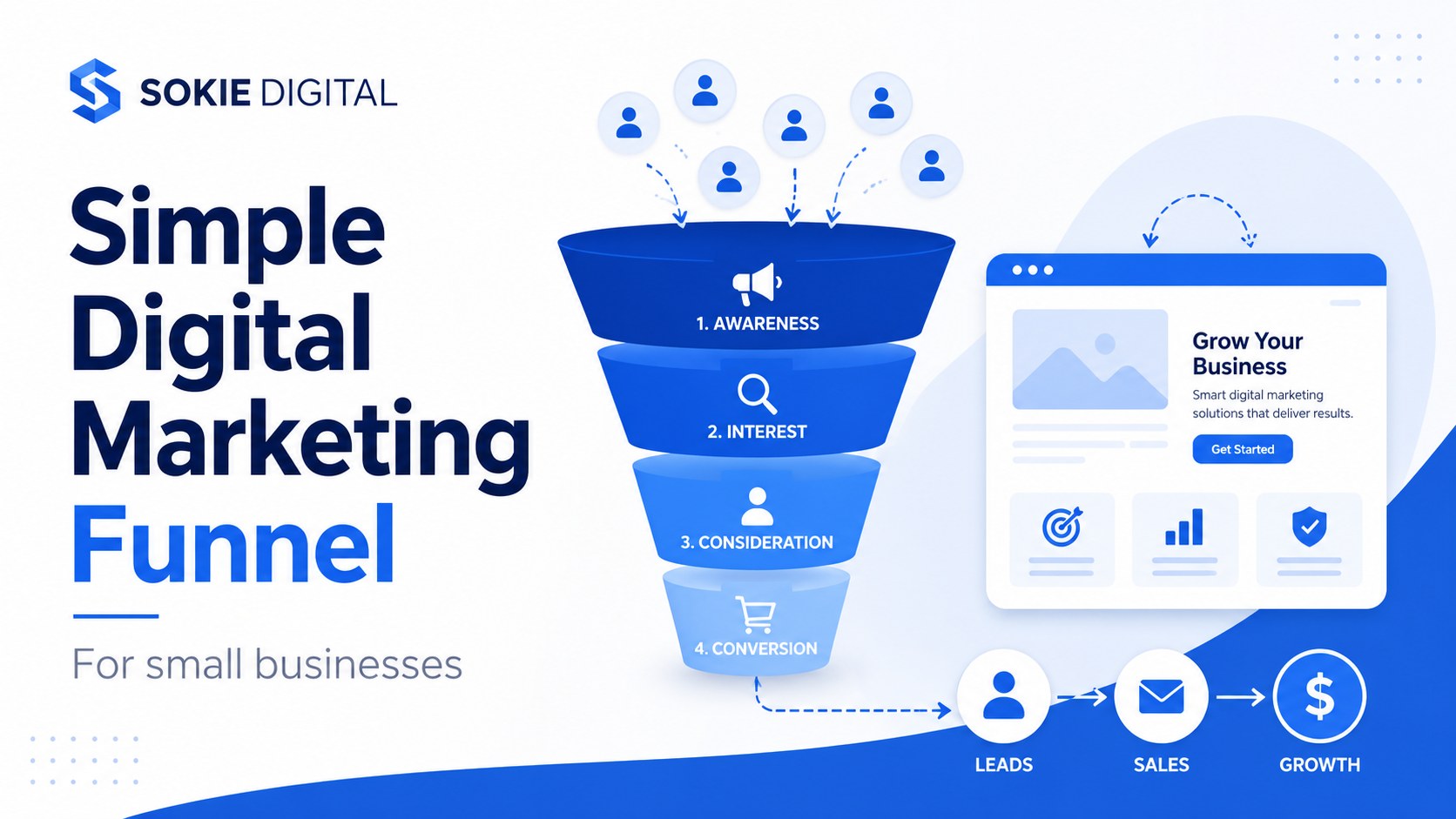
A digital marketing funnel is simply the path a person takes from first noticing your business to becoming a lead or customer. For small businesses, the funnel does not need to be complicated. It needs to be clear. The right people should be able to discover your business, understand the offer, trust what they see, and take the next step without confusion.
Many small businesses spend money on ads, social media posts, or flyers before fixing the page people land on. That creates a leak in the funnel. Attention is not enough. If visitors arrive on a weak website or unclear landing page, they may leave before contacting you.
Start with one clear offer
A funnel works best when it is built around a specific offer. “We do everything” is hard to market. “Book a website review,” “Request a cleaning quote,” “Schedule a consultation,” or “Get a custom website plan” gives the visitor a clear decision.
Before writing content or running campaigns, define the offer in one sentence. Who is it for? What problem does it solve? What should the customer do next? This sentence becomes the foundation for your landing page, ad copy, social posts, and follow-up message.
Build a landing page that matches the offer
A landing page should not feel like a random page from the website. It should match the promise that brought the visitor there. If a post says “website design for small businesses,” the page should immediately explain website design for small businesses, not force the visitor to search through a general homepage.
A useful landing page includes a clear headline, a short explanation, benefits, service details, proof, frequently asked questions, and a strong call to action. The page should answer the questions a serious customer would ask before reaching out.

Use content to create awareness
Content brings people into the funnel. Blog posts, short videos, social posts, email newsletters, and service guides can all help customers understand a problem and connect it with your service. The best content is not random; it is connected to the questions your customers already have.
For example, a website design company can write about website mistakes, local SEO, website maintenance, landing pages, pricing, and online credibility. Each topic attracts people who may need help with the same services the business offers.
Make the call to action specific
A vague call to action weakens the funnel. “Learn more” does not tell the visitor what will happen next. “Request a website quote,” “Book a free consultation,” or “Ask for a digital marketing plan” is stronger because it connects the action to the visitor’s goal.
Place the call to action near the top of the page, after important explanation sections, and again near the bottom. Some visitors are ready quickly. Others need more information first.
Add proof before asking for the enquiry
People rarely contact a business based on a claim alone. They want proof. That proof can come from reviews, client logos, project examples, before-and-after improvements, process explanations, certifications, or clear pricing guidance.
Proof does not have to be dramatic. A short project summary that explains the problem, what changed, and how the business improved can be more useful than a generic testimonial. The goal is to reduce doubt at the moment the visitor is deciding whether to act.
Connect SEO and paid campaigns to the funnel
SEO and paid marketing should send visitors to pages that match their intent. A person searching for “website management for small business” should not land on a broad page that barely mentions management. They should land on a page that explains updates, maintenance, edits, support, and the next step.
Search-friendly pages need useful content, clear headings, internal links, and helpful page structure. Google’s SEO Starter Guide is a good reference for understanding how to make pages useful and easier to navigate: Google Search Central SEO Starter Guide.

Follow up quickly
A funnel does not end when someone fills out a form. The follow-up matters. If a lead waits too long for a reply, the interest may fade or they may contact another provider. Small businesses should have a simple response process: confirm the enquiry, ask for missing details, explain the next step, and schedule the conversation.
Even a short, clear email can improve the experience: “Thanks for reaching out. I reviewed your request and can help with this. The next step is a short consultation so we can understand your goals and recommend the right plan.”
Measure the right funnel signals
Small businesses do not need to track everything at first. Start with a few practical numbers: website visits, page enquiries, contact form submissions, phone clicks, booking clicks, and the source of leads. These numbers show where people enter the funnel and where they stop.
If a page gets traffic but no enquiries, the offer, proof, layout, or call to action may need work. If people click the contact page but do not submit, the form may be too long or unclear. The goal is to improve the journey step by step.
A simple funnel structure
- Awareness: blog posts, social posts, search results, referrals, and ads.
- Interest: useful service pages and landing pages.
- Trust: reviews, proof, examples, process, and clear pricing direction.
- Action: quote request, call, email, booking, or consultation.
- Follow-up: fast response, clear next step, and organized communication.
A good funnel is not about tricking people. It is about removing confusion. When every step is clear, customers have fewer reasons to leave and more reasons to contact you.
Need a clearer funnel for your business? Explore Sokie Digital marketing support or contact Sokie Digital to plan your website and lead-generation path.